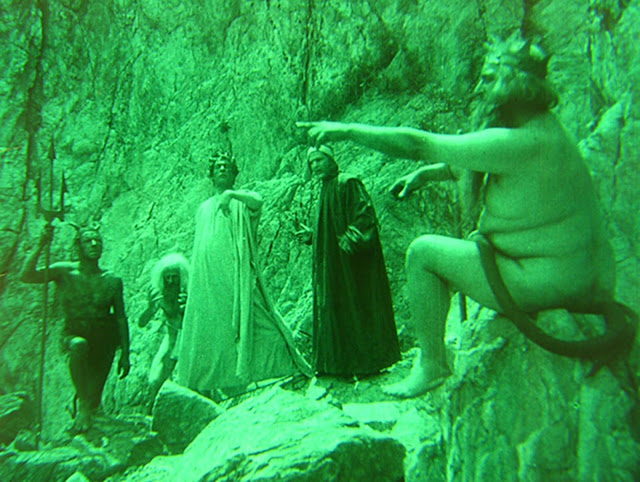
All right, it was another lovely day in the Castro. And a light day, just 5 movies.
First up was a presentation of OSWALD THE LUCKY RABBIT cartoons. This was Walt Disney's character before he started his eponymous company and created that mouse character. At the time the films were distributed by Universal Pictures, who held on to the rights and distributed the original silent films with new sound as well as producing new cartoons. But what we saw Sunday morning were the original silent cartoons produced by Disney and drawn by Ub Iwerks, introduced by Ub's granddaughter Leslie Iwerks (who is also a documentary filmmaker who made THE HAND BEHIND THE MOUSE: THE UB IWERKS
STORY and THE PIXAR STORY)
A lot of gags were re-used throughout the films, and really it doesn't make a lot of sense to recap the plots, since a lot of it is just free-wheeling, not-quite narrative logic fun. So I'll just list the films (from the program guide)
TROLLEY TROUBLE (1927)
OH TEACHER (1927)
GREAT GUNS (1927)
MECHANICAL COW (1927)
ALL WET (1927)
THE OCEAN HOP (1927)
BRIGHT LIGHTS (1928)
OH WHAT A KNIGHT (1928)
Donald Sosin accompanied the films on Piano, with his wife singing, his son doing vocal sound effects, and the audience joining in as instructed. For example, for ALL WET, we'd make ocean noises, for TROLLEY TROUBLE we'd be a clanging trolley bell, for OH TEACHER we'd be a school bell, etc. Lots of fun, and a good pick me up to start a long day of film.
For the next show, we started with a short that took us all the way back to 1900, THE BARBER'S QUEER CUSTOMER. A man sits in a barber shop chair, but before the barber can shave him, he turns into a monkey. And every time the barber turns around, he changes to a different face.
Then the feature was a Czech classic, EROTIKON. (I's not quite what you think, but it is pretty darn frank). George (Olaf Fjord) has a train to catch, but the rain slows him down, so he spends the night at a local house (once the master of the house sees his fine brandy, he's a welcome guest). That leads to an encounter with the man's daughter, Andrea (Ita Rina). But the next day he's on his train, and although she never forgets him (thanks no doubt the the baby growing inside her), he's soon on his way to other conquests. These lead to no end of complications. Well, Andrea tracks him down to Prague, but their baby (really hers, since he knows nothing about it) is stillborn. Meanwhile he's in all sorts of romantic troubles, dallying about with married women. The plot gets pretty convoluted, but needless to say it does not end well for him (or anyone, but most importantly for him). Of course, the love scenes are nowhere near as explicit as modern film, but it more than makes up with it in evocative sensuality (a simple closeup of a raindrop on a windowpane is actually very impressive).
The Mont Alto Orchestra once again provided the music, and I can just repeat what Dennis James said--they were perfection!
Next up was the Director's Choice, where the festival invites a famous director to choose a silent film to play in the festival. The director this year was Terry Zwigoff (GHOST WORLD, BAD SANTA), and he chose a W. C. Fields classic (interesting to see Fields without hearing that famous voice. Other than in my head, that is).
But first a short, THEIR FIRST DIVORCE CASE, which I had seen at the Broncho Billy Film Festival last year. Directed by Mack Sennet, it's a funny little comedy about private eyes hired by a wife to follow a cheating husband. They get the goods--too bad the husband and wife had patched things up and she was the girl they "caught" him with.
The feature was SO'S YOUR OLD MAN, and showcases classic Fields as a good natured, rough-edged drunk. Although he's also a genius glazier, who has invented an unbreakable glass windshield which will make him a fortune. But for now, he's a rough-edged drunk, much to the chagrin of his wife, who comes from a high class family but now has no social life between the laundry and the stove. However, that might all change since the son of the classiest family in town has his eye on their daughter. But then Fields meets the snooty, stuck up mother, and of course that destroys any chance. In the meantime, Fields goes to Washington for a meeting of auto makers to show off his windshield. The windshield really is unbreakable, but his car is towed and he accidentally smashes the windshields of a couple other cars, both destroying his deal and leaving him running for his life. On the train home, he contemplates (and comes close to attempting) suicide. Finally thinking the better, he meets a bored woman and talks to her (seeing a bottle of iodine labelled "poison", he thinks she had the same idea). Turns out, she's the princess of Spain, and is sad because she's bored and feels useless. Turns out helping Fields is just the pick-me-up she needs. To bad their close talking is witnessed by busybody ladies from his town, so by the time he gets home his 'philandering' is the talk of town. But when the princess shows up to visit him, suddenly the snobs who would cross the street if they saw him coming all want to be his best friend. Hilarious, ending with some fantastic physical hi-jinks on a golf course (with a caddy who really doesn't like him).
The film was accompanied by the always excellent Dr. Phil Carli on piano.
Next up was THE FALL OF THE HOUSE OF USHER. The original preceding short was supposed to be GETTING EVEN (1909, D. W. Griffith, Mary Pickford), but the print that arrived was 16 mm, and the Castro does not play 16 mm. So pianist Stephen Horne had a bright idea, play the abstract surrealist short THE FALL OF THE HOUSE OF USHER (1928 by James Sibley Watson). Of course, no time to get a film print, but it's on the DVD set Treasures from American Film Archives. Ummm...I couldn't tell you what happened, it's far too abstract. But it was beautiful.
Oddly the feature THE FALL OF THE HOUSE OF USHER, was made the same year by Jean Epstein in France, and is considered a classic of surrealist cinema (Luis Buñuel was assistant director until Epstein fired him...let's say for "creative differences"...and told him to stay the hell away from surrealism). Odd that this one was made by the famous surrealists, because it was far more straightforward than the American short version. It takes quite a few liberties with Poe's story (Madeline Usher is Roderick's wife, not his sister, and they both actually survive the fire and collapse of the house), but it keeps a creepy, dreamlike (that's surrealism for you) look, feel, pace, and logic throughout.
Stephen Horne (now an unofficial assistant festival programmer) accompanied again on the piano.
And finally we came to the last show of the festival (12 movies crammed into one dense weekend).
First the short, THE LESSER EVIL. Again, a Griffith Biograph short, and like so much cinema of any era, it showcases a girl and a chase. The girl is Blanch Sweet. The chase comes because she's kidnapped by smugglers when she accidentally overhears their plan. Her boyfriend and the police are chasing them, but on the boat the crew is eager to have a little fun with her. But the captain will have none of it (making him, I suppose, the titular lesser evil). Interesting that while her boyfriend and the police finally catch up and arrest the smugglers, it's the captain who fended them off and really saved her. In thanks, she keeps him hidden and lets him escape (presumably totally reformed, never to break the law again).
And the final feature, LADY OF THE PAVEMENTS, brought us back to the leading lady of the opening film, the Mexican spitfire Lupe Velez, this time teaming with director D. W. Griffith. It also brought us to 1929, the year when all studios were transitioning to sound. Griffith shot this as a silent, but then had to go back and shoot a little dialogue and record some songs to make it a "partial-talkie". About half the songs are lost, but one--Irving Berlin's "Where is the Song of Songs For Me?"--is well known (and was sung by Lupe Velez herself for the soundtrack). Problems with the sound recordings made this film a flop on the initial release, and caused UA chief Joseph Schenck to issue ultimatums about the technology for sound recordings in the future. The version we got thankfully had no recording glitches, because all the sounds were live, provided by Donald Sosin on the piano with Joanna Seaton singing the few of the songs that are known (including, of course "Where is the Song of Songs For Me?")
The story is about Karl (William Boyd), a German diplomat in Paris, who is engaged to the height of Paris social circles, Countess Diane des Granges (Jetta Goudal). When he catches her cheating on him, he'll have none of it, even if she's cheating on him with the Emperor of France himself (which she is). He calls off the wedding and insists he'd rather marry a girl from the streets than her. So she arranges just that, hiring cabaret singer Nanon del Rayon (Lupe Velez) to pose as an aristocratic lady and make Karl fall in love with her to teach him a lesson. Her plan works perfectly--too perfectly, as both Karl and Nanon fall for each other (in no small part due to the song she sings). Diane lets it go way too far before she reveals her trick in the cruelest manner possible. But, to no one's surprise, love conquers all. The final scene, where she's singing "Where is the Song of Songs For Me?" and all the bar customers are turning into Karl is really quite beautiful.
And that's the way SF2F ended. it was just one weekend, but still a really exhausting, intense festival. On the one hand, I'd love it to get so huge that it plays a full week or more. On the other hand, I don't think I could survive that.
Tuesday, July 14, 2009
Monday, July 13, 2009
Jason goes to the Silent Film Festival--Day 2
Saturday was a grueling marathon day in which I entered the Castro Theater about 9:30 am and didn't step outside once until after midnight.
The marathon started with a program of "Tales From The Archives". Fascinating pieces of film restoration, starting with Anne Smatla, the winner of last year's post-doctoral restoration grant. She restored SCREEN SNAPSHOTS #7, one of many "behind the scenes" shorts that mixed skits with an inside look at the studio. This one starred Lloyd Hamilton in blackface(!) being treated as a stranger on set until he washes it off and is once again a recognizable star (yikes!)
Joe Lindner and Heather Olson of the Academy Film Archive (mostly Heather) presented the rest of the restorations. The second restoration was Thanhouser's THE ACTORS CHILDREN, a nearly complete "fragment film" with a few frames too badly decomposed to see (although the scenes in general are intact) and the end missing (although the story is pretty close to resolved). An acting family struggles to make rent, and in fact while mom and dad are looking for work they're evicted and the kids are thrown on the street. But the kids are natural dancing hams and
are taken in by an organ grinder. When they prove successful, they're stolen again by the local theater and put on stage. Meanwhile, mom and dad are fantically searching for them, when he gets a telegram that a wealthy relative died and left him $1 million. Eventually they find their kids on stage, take them back and...the ending is missing.
Then we were treated to a Trailer of POLLY OF THE FOLLIES, a film that is otherwise completely lost. Constance Talmadge in her "best, longest, and DOUBLE role" as both a Ziegfeld engenue and as Cleopatra (there's some time travel involved, at least in the imagination).
Then we got into even smaller fragments, as only a few isolated frames were left of the trailer to Coleen Moore's (star of last year's restoration showcase HER WILD OAT) HAPPINESS AHEAD. Not much to say...just a few frames of Moore.
There was another one...that slips my mind right now. Dangit, again it was just a few frames from a trailer to a lost film.
And finally, we reversed the trend with a fully intact Edison short (but one that was completely unknown) HOW THE HUNGRY MAN WAS FED. A poor, starving man begs for coins, but keeps begging the same people. They switch hats and coats and keep giving him coins until know he has plenty of money for food. So they take him to a fine restaurant and fill his belly, then force him to pay up.
Stephen Horne provide piano accompaniment for the whole program.
Then there wasn't much time to turn the theater over to the next show. First up was a short THEY WOULD ELOPE from the American Biograph company (you can see their logo on set as a copyright protection), directed by D. W. Griffith and starring America's sweetheart Mary Pickford. A young couple in love, but her dad ostensibly doesn't approve. So they decide to run off, and she leaves her parent's a note. Turns out running off doesn't quite work, as they have a variety of transportation troubles, culminating in a capsized canoe. Meanwhile, turns out mom and dad are thrilled their little daughter is getting married, and plan a giant party. They return completely dishevelled after their elopement failure, and are surprised to see a wedding party waiting for them.
And then the feature, another restoration project, BARDELYS THE MAGNIFICENT starring John Gilbert (whose daughter, granddaughter, and great-grandson were in the audience) and directed by King Vidor (their final collaboration). Long thought lost, a print was found and restored by David Shepard last year. It was missing one reel which is filled in with stills and intertitles. The print was found in France and the French intertitles apparently were much different from the original English, which was still available from the MGM archives. Funds have not yet been raised to strike a new 35 mm print, so this restoration was shown on video (BetaSP I think David said, but I could be wrong). Anyway, it still looked great.
John Gilbert plays the titular Bardelys, the greatest lover in all French aristocracy. Such a great lover that his prowess stirs the envy of Count Chatellerault (Roy D'arcy). He has just failed to seduce Lady Roxalanne de Lavedan (Eleanor Boardman), who doesn't spend much time in the royal court, and so isn't much of a liar. When Bardelys mocks Chatellerault's failure at a party, they get into a fight that ends with a bet. If Bardelys cannot get Lady de Lavedan to marry him, Catellerault will get Bardelys's entire estate. It's an outrageous tale that of course involves double-crosses. Bardelys makes it to Lavedan's estate, but is badly injured. Hiding out as the leader of the anti-royal renegades (lucky, since the Lavedans are sympathetic), his "recovery" takes a long time so he can spend more time with Roxalanne. Seduction achieved--almost. Turns out the real rebel leader has a fiancee who writes to him. Roxalanne betrays him to the Royal authorities, where despite his pleas of mistaken identity he's sentenced to death. Carrying out the sentence--Count Chatellerault (Boo! Hiss!) But with a bit of Fairbanksian acrobatics, Bardelys stalls until the king arrives and recognizes him. Chatellarault gets his comeuppance, and Bardelys and Lavedan are married (oh yeah, he had actually fallen in love with her).
The costumes were outrageously foppish, the dialogue was hilariously bawdy (you fight so hard, I'd swear you were fighting for someone else's wife!), and all in all it's a delightfully silly adventure.
Music was again provided by the Mont Alto Motion Picture Orchestra, who were again awesome.
Next up we went to China for WILD ROSE. But first, there was a special first ever SFSFF "Living Legends" award presentation to Qin Yi, the widow of star Jin Yan, and a famous actress in her own right. She spoke briefly about Jin Yan, his charm, and his perfectionism.
As for the movie, it's a beautiful romance and a great look at pre-WWII China. Particularly, Shanghai--the cosmopolitan city of wealthy businessmen from around the world, and the poor people of the countryside just out of town. One of those country girls is the young, beautiful, and vivacious Xiao Feng, nicknamed the titular Wild Rose (playced by Wang Renmei, nicknamed the "Wildcat"). In the opening shot her adoring father is looking for her while she's sneaking around outside to surprise him. She plays general to all the kids in town, leading them as they pretend to march in the army defending China (and the "Do you love China?/I love mommy!" is adorable in any language). Xiao Feng catches the eye of a handsome artist from Shanghai (Jin Yan, who married Renmei after filming, so there's some real chemistry on screen). When her father runs off, (presumed dead, after fighting with a local bar owner who wanted to marry her) she moves to the city with her artist boyfriend. But her country ways displease his father, and when she can't pass for a cultured city lady, his father (and the source of all his wealth) tells him to either get rid of her or leave. He chooses the latter, and for a summer they live the bohemian lifestyle with another friend of his (a failed artist who now paints billboards). The summer is great, but the winter is impossible. In a moment of weakness she steals a dropped wallet. He takes the rap, and she goes to his father to plead for him to help his son. He insists he has no son, until she agrees to go away and never see him again. Only in a romance like this could a war (the Japanese invasion) be a good thing, as he remembers how she lead the child troops back in her village. Assuming she'd enlist for the love of China, he leaps from his father's comfortable house to join the marching volunteers, and finds her immediately. The ending is very abrupt, perhaps the only weakness in this otherwise beautiful film.
This show featured piano accompaniment by Donald Sosin.
The next show started with another Biograph short by D. W. Griffith, THE VOICE OF THE VIOLIN. A weird story of a music teacher spurned by his lovely student Helen. In despair, he joins an anarchist group and draws the short straw for the mission to bomb the capitalist's house. But when he finds out it's Helen's house, he has a change of heart and now has to stop the bomb.
And that brought us into the world of noir (or proto-noir...at least one of the earliest gangster films), with the feature UNDERWORLD (introduced by Eddie Muller, the Czar of Noir, and host of the excellent Noir City Film Festival in January). Written by Ben Hecht, the Chicago newspaperman who became the greatest noir writer (or writer, period) in Hollywood history. He went on to write SCARFACE, but he won his first Academy Award and the first Academy Award ever for screenwriting for UNDERWORLD. The film was directed by Josef Von Sternberg (THE BLUE ANGEL), and while his visual style was excellent his sentemantility pissed Hecht off so much he insisted his name be removed from the finished film (remember, Hecht went on to win the first screenwriting Oscar ever for a film he wanted to disown, that's how freakin' hard-boiled he was).
It's the Chicago gangster story of Bull Weed, king of the underworld. As the movie opens, he's robbing a bank and is witnessed by a down on-his-luck drunk bum, who insists he's a "Rolls Royce" at keeping quiet. With that line, he earns Bull's friendship and his nickname. Later at the bar Bull lords over the other gangsters, especially rankling Buck Mulligan. Yup, Bull's got the brains (especially with the help of Rolls Royce, who turns out to be a very well-read lawyer) and the brawn to rule the underworld, but like all good gangsters his weakness is his dame. In this case, Feathers, his gal with a penchant for feather boas. For a time it looks like Feathers might be getting a bit too friendly with Rolls, but the bigger problem is the big underworld party where all the rival gangs call a truce for the night. Specifically, the problem is Buck, who tries to force himself on Feathers. In a drunken rage Bull chases Buck all the way to his flower shop Yup, Buck's cover business is a flower shop, where in the back he's planning an arrangement to put on Bull's grave. But Bull guns him down right there in his shop, and even the king of the underworld can't escape the law on something like that. Stewing in prison (BTW, up to this point, every feature included a jail scene. The theme didn't last), Bull is sure Feathers and Rolls are cheating on him and will leave him to hang while they run off together. In reality, they're plotting to bust him out, but their plot is foiled while Bull breaks out on his own. It all leads to a climactic shootout that rivals anything in modern film, and Bull learns his obligatory lesson. Awesome.
Stephen Horne (the indefatigable) returned to do the piano accompaniment.
Once again the next show opened with a Griffith Biograph short, this time THE TRICK THAT FAILED. Mary Pickford is Nellie, a struggling artist who refuses to marry until she proves she's a success. Her wealthy, handsome suitor Billy hatches a plan to pay his servants to go buy up all her paintings. At first she's thrilled and will marry him, until the trick is discovered and she's so offended that she instead accepts the proposal of his rival (a goofy looking, bald man. Ooh, burn on Billy! BTW, an excellent message that even the ugliest man can land Mary Pickford. I'm sure that helped her popularity)
The feature was a Lillian Gish drama, THE WIND. This was Gish's last silent film, and the last film in Hollywood for Swedish director Victor Sjöström. When it was released (in 1928), it was critically mixed and a commercial flop, and ended Gish's relationship with MGM. However, she got the last laugh when it was added to the National Film Registry in 1993. Gish always talked about how this was her hardest film to make, and well in to her 80's and 90's (she lived to be just short of 100) she was touring with this film and others. In those tours the accompaniast was the acclaimed organist Dennis James. For the performance last Saturday, the accompaniast was also acclaimed organist Dennis James on the Mighty Wurlitzer, plus sound effects artists on two wind machines (plus a few other effects, like a cap gun that did a great job of making the audience jump). By the way, Dennis performed for two films of the festival, but was in the audience watching the other 10 (for at least a few, in the row right behind me). He's a fan, he's very personable, and told some funny stories about Lillian Gish (like how she advised him never to get married). He's not just a great musician and silent film accompaniast, he's officially a cool guy.
Now (finally) to the film. Gish plays Letty, a girl from Virginia who's moving out to Texas to live on her cousin's ranch. While still on the train, the fierce winds appear as a character as much as a force of nature. When she arrives, as the beautiful new lady in town she attracts the attention of all the neighbors. That's not so bad. The bad thing is she attracts the wrath of her cousin's wife, Cora. She's not just jealous of the attention her children pay to Letty, she's jealous of the attention her husband pays to her (um...nothing happens. And gross, they're cousins!) She's kicked out of the house with no place to live and the relentless wind driving her madder and madder every minute. She agrees to marriage, but it's a loveless marriage of convenience. At least, it's loveless on her end, he loves her but she's disgusted by him. In a way, her home becomes a prison with the wind as the ever watchful guard (there, I kept the prison theme going one more movie!) Well, there's a climax with yet another suitor who just can't give her up no matter how married she is, and finally she learns to love the wind (after all, any force of nature that will bury a body is a friend of mine).
The version of THE WIND we saw had a happy ending, but an original ending--with Letty going mad and walking off into the wind--is rumored to exist (and there are also rumors that the original "going crazy and walking off into the desert ending is just a rumor and never existed).
And finally, this incredible marathon day (15+ hours without even leaving the theater) came to an end in Russia (and worlds beyond) with AELITA, QUEEN OF MARS. A Soviet scientist intercepts a mysterious radio message, and sets to work decoding it. He quickly discovers it's not from earth, but from Mars, and his mind goes wild searching for answers. Meanwhile, on Mars queen Aelita rules over the totalitarian society/cubist wet dream. Although she's on the throne, a council of elders really rules the society. She watches earth as much as she can, but the council locks her out of the observatory. Meanwhile, they've decided to cut costs they'll keep half of their slave laborers in the refrigerator for later.
So far I've described mostly what's happening on Mars, but actually most of the movie takes place in Moscow. That's because the Mars scenes were awesome, and the Moscow scenes bored and confused me (hey it was late, I hadn't left the theater for 15 hours at this point). There's an affair (I think), some crime trouble...I don't know, eventually the scientist builds his rocket and he and a couple other men travel to Mars, meet queen Aelita, and provoke a Bolshevik Revolution. Damn straight, they turn it into the Soviet Socialist Republic of Mars!
Dennis James was back on the Mighty Wurlitzer (for the Moscow scenes) and a Theremin (for the Mars Scenes), and Mark Goldstein was on Buchla Lightning sticks.
Awesome, and as I drove home, I end the night with this image and thought:

Does Queen Aelita have 3 boobs?
The marathon started with a program of "Tales From The Archives". Fascinating pieces of film restoration, starting with Anne Smatla, the winner of last year's post-doctoral restoration grant. She restored SCREEN SNAPSHOTS #7, one of many "behind the scenes" shorts that mixed skits with an inside look at the studio. This one starred Lloyd Hamilton in blackface(!) being treated as a stranger on set until he washes it off and is once again a recognizable star (yikes!)
Joe Lindner and Heather Olson of the Academy Film Archive (mostly Heather) presented the rest of the restorations. The second restoration was Thanhouser's THE ACTORS CHILDREN, a nearly complete "fragment film" with a few frames too badly decomposed to see (although the scenes in general are intact) and the end missing (although the story is pretty close to resolved). An acting family struggles to make rent, and in fact while mom and dad are looking for work they're evicted and the kids are thrown on the street. But the kids are natural dancing hams and
are taken in by an organ grinder. When they prove successful, they're stolen again by the local theater and put on stage. Meanwhile, mom and dad are fantically searching for them, when he gets a telegram that a wealthy relative died and left him $1 million. Eventually they find their kids on stage, take them back and...the ending is missing.
Then we were treated to a Trailer of POLLY OF THE FOLLIES, a film that is otherwise completely lost. Constance Talmadge in her "best, longest, and DOUBLE role" as both a Ziegfeld engenue and as Cleopatra (there's some time travel involved, at least in the imagination).
Then we got into even smaller fragments, as only a few isolated frames were left of the trailer to Coleen Moore's (star of last year's restoration showcase HER WILD OAT) HAPPINESS AHEAD. Not much to say...just a few frames of Moore.
There was another one...that slips my mind right now. Dangit, again it was just a few frames from a trailer to a lost film.
And finally, we reversed the trend with a fully intact Edison short (but one that was completely unknown) HOW THE HUNGRY MAN WAS FED. A poor, starving man begs for coins, but keeps begging the same people. They switch hats and coats and keep giving him coins until know he has plenty of money for food. So they take him to a fine restaurant and fill his belly, then force him to pay up.
Stephen Horne provide piano accompaniment for the whole program.
Then there wasn't much time to turn the theater over to the next show. First up was a short THEY WOULD ELOPE from the American Biograph company (you can see their logo on set as a copyright protection), directed by D. W. Griffith and starring America's sweetheart Mary Pickford. A young couple in love, but her dad ostensibly doesn't approve. So they decide to run off, and she leaves her parent's a note. Turns out running off doesn't quite work, as they have a variety of transportation troubles, culminating in a capsized canoe. Meanwhile, turns out mom and dad are thrilled their little daughter is getting married, and plan a giant party. They return completely dishevelled after their elopement failure, and are surprised to see a wedding party waiting for them.
And then the feature, another restoration project, BARDELYS THE MAGNIFICENT starring John Gilbert (whose daughter, granddaughter, and great-grandson were in the audience) and directed by King Vidor (their final collaboration). Long thought lost, a print was found and restored by David Shepard last year. It was missing one reel which is filled in with stills and intertitles. The print was found in France and the French intertitles apparently were much different from the original English, which was still available from the MGM archives. Funds have not yet been raised to strike a new 35 mm print, so this restoration was shown on video (BetaSP I think David said, but I could be wrong). Anyway, it still looked great.
John Gilbert plays the titular Bardelys, the greatest lover in all French aristocracy. Such a great lover that his prowess stirs the envy of Count Chatellerault (Roy D'arcy). He has just failed to seduce Lady Roxalanne de Lavedan (Eleanor Boardman), who doesn't spend much time in the royal court, and so isn't much of a liar. When Bardelys mocks Chatellerault's failure at a party, they get into a fight that ends with a bet. If Bardelys cannot get Lady de Lavedan to marry him, Catellerault will get Bardelys's entire estate. It's an outrageous tale that of course involves double-crosses. Bardelys makes it to Lavedan's estate, but is badly injured. Hiding out as the leader of the anti-royal renegades (lucky, since the Lavedans are sympathetic), his "recovery" takes a long time so he can spend more time with Roxalanne. Seduction achieved--almost. Turns out the real rebel leader has a fiancee who writes to him. Roxalanne betrays him to the Royal authorities, where despite his pleas of mistaken identity he's sentenced to death. Carrying out the sentence--Count Chatellerault (Boo! Hiss!) But with a bit of Fairbanksian acrobatics, Bardelys stalls until the king arrives and recognizes him. Chatellarault gets his comeuppance, and Bardelys and Lavedan are married (oh yeah, he had actually fallen in love with her).
The costumes were outrageously foppish, the dialogue was hilariously bawdy (you fight so hard, I'd swear you were fighting for someone else's wife!), and all in all it's a delightfully silly adventure.
Music was again provided by the Mont Alto Motion Picture Orchestra, who were again awesome.
Next up we went to China for WILD ROSE. But first, there was a special first ever SFSFF "Living Legends" award presentation to Qin Yi, the widow of star Jin Yan, and a famous actress in her own right. She spoke briefly about Jin Yan, his charm, and his perfectionism.
As for the movie, it's a beautiful romance and a great look at pre-WWII China. Particularly, Shanghai--the cosmopolitan city of wealthy businessmen from around the world, and the poor people of the countryside just out of town. One of those country girls is the young, beautiful, and vivacious Xiao Feng, nicknamed the titular Wild Rose (playced by Wang Renmei, nicknamed the "Wildcat"). In the opening shot her adoring father is looking for her while she's sneaking around outside to surprise him. She plays general to all the kids in town, leading them as they pretend to march in the army defending China (and the "Do you love China?/I love mommy!" is adorable in any language). Xiao Feng catches the eye of a handsome artist from Shanghai (Jin Yan, who married Renmei after filming, so there's some real chemistry on screen). When her father runs off, (presumed dead, after fighting with a local bar owner who wanted to marry her) she moves to the city with her artist boyfriend. But her country ways displease his father, and when she can't pass for a cultured city lady, his father (and the source of all his wealth) tells him to either get rid of her or leave. He chooses the latter, and for a summer they live the bohemian lifestyle with another friend of his (a failed artist who now paints billboards). The summer is great, but the winter is impossible. In a moment of weakness she steals a dropped wallet. He takes the rap, and she goes to his father to plead for him to help his son. He insists he has no son, until she agrees to go away and never see him again. Only in a romance like this could a war (the Japanese invasion) be a good thing, as he remembers how she lead the child troops back in her village. Assuming she'd enlist for the love of China, he leaps from his father's comfortable house to join the marching volunteers, and finds her immediately. The ending is very abrupt, perhaps the only weakness in this otherwise beautiful film.
This show featured piano accompaniment by Donald Sosin.
It's the Chicago gangster story of Bull Weed, king of the underworld. As the movie opens, he's robbing a bank and is witnessed by a down on-his-luck drunk bum, who insists he's a "Rolls Royce" at keeping quiet. With that line, he earns Bull's friendship and his nickname. Later at the bar Bull lords over the other gangsters, especially rankling
Stephen Horne (the indefatigable) returned to do the piano accompaniment.
Now (finally) to the film. Gish plays Letty, a girl from Virginia who's moving out to Texas to live on her cousin's ranch. While still on the train, the fierce winds appear as a character as much as a force of nature. When she arrives, as the beautiful new lady in town she attracts the attention of all the neighbors. That's not so bad. The bad thing is she attracts the wrath of her cousin's wife, Cora. She's not just jealous of the attention her children pay to Letty, she's jealous of the attention her husband pays to her (um...nothing happens. And gross, they're cousins!) She's kicked out of the house with no place to live and the relentless wind driving her madder and madder every minute. She agrees to marriage, but it's a loveless marriage of convenience. At least, it's loveless on her end, he loves her but she's disgusted by him. In a way, her home becomes a prison with the wind as the ever watchful guard (there, I kept the prison theme going one more movie!) Well, there's a climax with yet another suitor who just can't give her up no matter how married she is, and finally she learns to love the wind (after all, any force of nature that will bury a body is a friend of mine).
The version of THE WIND we saw had a happy ending, but an original ending--with Letty going mad and walking off into the wind--is rumored to exist (and there are also rumors that the original "going crazy and walking off into the desert ending is just a rumor and never existed).
And finally, this incredible marathon day (15+ hours without even leaving the theater) came to an end in Russia (and worlds beyond) with AELITA, QUEEN OF MARS. A Soviet scientist intercepts a mysterious radio message, and sets to work decoding it. He quickly discovers it's not from earth, but from Mars, and his mind goes wild searching for answers. Meanwhile, on Mars queen Aelita rules over the totalitarian society/cubist wet dream. Although she's on the throne, a council of elders really rules the society. She watches earth as much as she can, but the council locks her out of the observatory. Meanwhile, they've decided to cut costs they'll keep half of their slave laborers in the refrigerator for later.
So far I've described mostly what's happening on Mars, but actually most of the movie takes place in Moscow. That's because the Mars scenes were awesome, and the Moscow scenes bored and confused me (hey it was late, I hadn't left the theater for 15 hours at this point). There's an affair (I think), some crime trouble...I don't know, eventually the scientist builds his rocket and he and a couple other men travel to Mars, meet queen Aelita, and provoke a Bolshevik Revolution. Damn straight, they turn it into the Soviet Socialist Republic of Mars!
Dennis James was back on the Mighty Wurlitzer (for the Moscow scenes) and a Theremin (for the Mars Scenes), and Mark Goldstein was on Buchla Lightning sticks.
Awesome, and as I drove home, I end the night with this image and thought:

Does Queen Aelita have 3 boobs?
Saturday, July 11, 2009
Jason goes to the Silent Film Festival--opening night.
The 14th San Francisco Silent Film Festival (or (SF)2 Fest) started Friday night, and we jumped right into the action with a gorgeous restored print of Douglas Fairbanks in THE GAUCHO. Although one part that hasn't been completely restored is the two color (red and green)Technicolor scene of Mary Pickford as the Virgin Mary. It was in black and white in the film, but we were treated to a 6 minute reel of two color Technicolor outtakes of the scene. Mary Pickford standing tall looking divine with a rotating ring of pliable metal stick blasted by a floodlight creating a holy aura around her (not, as an early critic surmised, a penny sparkler behind her head).
Anyway, on to the movie, which takes place in the city of the Miracle. It is so named because when a young shepherd girl fell from a cliff rather than dying she saw a vision of the Madonna (Pickford) and was unharmed. Moreover, her prayers could heal the sick. They built a shrine, and then a city around it where pilgrims would come to donate their gold and pray (and, of course, be healed). However, as the shrines coffers (used to aid the poor) grew, a usurper named Ruiz seized control, demanding that every transaction be done through his agents.
Enter the Gaucho, a dashing Douglas Fairbanks who showcases his athleticism just as much as his skill lighting a cigarette (there's not a move he makes that doesn't flash somehow). He's an outlaw, but an incredibly popular one. When he rides into a mountain town with his gang, he ends up disarming the local authority, getting a round for everyone at the bar, and signing his own wanted poster. He also gets a new girlfriend, his ardent admirer played by the spitfire Lupe Velez. When she isn't fast enough finishing dinner, he hitches his men's horses to the floorboards and drags half the bar with him, creating (I suppose) the world's first mobile home.
Back to the city of the Miracle. Ruiz's troops are in control, but with a little daring-do, The Gaucho changes that and seizes power. Although he's an outlaw, he doesn't tolerate one of his men attacking the priest of the Shrine. It's not about religion, he's just against beating up an old man. But he's intrigued by the padre's decision to forgive his attacker, so he insists the padre attend a feast he's throwing that night.
Anyway, I don't want to recap the whole plot. There's some double-crossing, some black doom (a slow, lingering death), and a showdown with Ruiz. The Gaucho decides to follow the padre's holy book, and I decide I want to be Douglas Fairbanks when I grow up.
The Gaucho is a distinctly darker story than most of Fairbanks' other swashbucklers (although Fairbanks keeps it pretty light, clowning through the movie with ease and grace up until the Black Doom gets him), and Lupe Velez, the Mexican Spitfire, is a more spirited heroine than just about any other actress (no damsel in distress, here). All this makes for a film that is definitely still enjoyable for modern audiences (you could even argue it works better now than it did when it was released--to more or less mixed reviews).
The film was accompanied live by a brand new score by the Mont Alto Motion Picture Orchestra, and afterwards they (and the film) got a standing ovation. Awesome opening, can't wait for the rest of the festival.
Anyway, on to the movie, which takes place in the city of the Miracle. It is so named because when a young shepherd girl fell from a cliff rather than dying she saw a vision of the Madonna (Pickford) and was unharmed. Moreover, her prayers could heal the sick. They built a shrine, and then a city around it where pilgrims would come to donate their gold and pray (and, of course, be healed). However, as the shrines coffers (used to aid the poor) grew, a usurper named Ruiz seized control, demanding that every transaction be done through his agents.
Enter the Gaucho, a dashing Douglas Fairbanks who showcases his athleticism just as much as his skill lighting a cigarette (there's not a move he makes that doesn't flash somehow). He's an outlaw, but an incredibly popular one. When he rides into a mountain town with his gang, he ends up disarming the local authority, getting a round for everyone at the bar, and signing his own wanted poster. He also gets a new girlfriend, his ardent admirer played by the spitfire Lupe Velez. When she isn't fast enough finishing dinner, he hitches his men's horses to the floorboards and drags half the bar with him, creating (I suppose) the world's first mobile home.
Back to the city of the Miracle. Ruiz's troops are in control, but with a little daring-do, The Gaucho changes that and seizes power. Although he's an outlaw, he doesn't tolerate one of his men attacking the priest of the Shrine. It's not about religion, he's just against beating up an old man. But he's intrigued by the padre's decision to forgive his attacker, so he insists the padre attend a feast he's throwing that night.
Anyway, I don't want to recap the whole plot. There's some double-crossing, some black doom (a slow, lingering death), and a showdown with Ruiz. The Gaucho decides to follow the padre's holy book, and I decide I want to be Douglas Fairbanks when I grow up.
The Gaucho is a distinctly darker story than most of Fairbanks' other swashbucklers (although Fairbanks keeps it pretty light, clowning through the movie with ease and grace up until the Black Doom gets him), and Lupe Velez, the Mexican Spitfire, is a more spirited heroine than just about any other actress (no damsel in distress, here). All this makes for a film that is definitely still enjoyable for modern audiences (you could even argue it works better now than it did when it was released--to more or less mixed reviews).
The film was accompanied live by a brand new score by the Mont Alto Motion Picture Orchestra, and afterwards they (and the film) got a standing ovation. Awesome opening, can't wait for the rest of the festival.
Friday, July 10, 2009
Jason goes to Thrillville and sees SUGAR BOXX and ISLE OF THE DAMNED
So Thrillville was an institution at the Parkway (R.I.P. No, wait, rise from the dead and live to the end of time) and Will "The Thrill" Viharo and his wife Monica the Tiki Goddess would play crappy movies from the 50's, 60's, and 70's (okay, and sometimes the 40's and 80's). But last Thursday night in San Jose (conflicting with music in the park, making parking a fucking mess) they played new crappy grindhouse movies. In fact, it was a pair of world premieres.
First up was a Women In Prison (WIP) flick, SUGAR BOXX. A TV reporter gets a letter from an old friend who says her niece is in trouble in the Sugar State Correctional Facility, so she decides to go undercover. Almost all the inmates are there for prostitution and drugs, and almost all from Tallahassee (oh yeah, it takes place in Florida). So she dresses up like a whore, and drives there. She doesn't even get to town before the corrupt sheriff pulls her over, plants drugs in her trunk, and gets sent up for 15 years (with the help of a judge played by Jack Hill). Sugar State is supposedly not an easy place to survive, despite apparently not having an actual prison facility (she has the choice between either a camp or essentially a whorehouse). Yeah, the lusty warden is a corrupt, thieving lesbo. And so, apparently, are most of the inmates. Well, she survives, the plot progresses kind of predictably (i.e., there are lots of excuses for tits to come out on screen). This was not actually all that bad. It was cheap, sleazy, and I still can't quite get used to seeing a 70's style grindhouse flick shot on (rather poor) digital video. But at least it was a fairly faithful homage.
The second film I started out wanting to like much more. ISLE OF THE DAMNED is a "newly discovered" 80's Italian cannibal flick. And when it opened with text explaining how the director Antonello Giallo fled the country rather than produce proof that the actors were actually alive, and then it launched into the cheesy synthesizer score, I was all on board. The opening credits had me hooked, and then they started talking and quickly went full retard (you never go full retard). Okay, I'm fine with the bad dubbing, that's part of the genre, but don't dub such ridiculous voices. Likewise no need for the ridiculous fake mustaches or the semi-retarded kid. This is a perfect example of where less could be much, much more. The plot involves explorers--a greedy treasure hunter, his guide, and his (the guide's) troubled adopted son searching for the treasure of Marco Polo. There's only one island they haven't searched, and the guide refuses to go because it's inhabited by cannibals. But the greedy bastard forces them to go anyway, and havoc ensues. They meet one daughter who survived her father being eaten (and de-phallused) in front of her, and an eccentric aristocrat with a yakuza assassin sidekick who rescues them. The aristocrat is always talking about how "civilized" man is the real savage (another Italian cannibal flick cliche). More havoc ensues, lots of death, lots of ass-rape, and lots of tedium. I was just left with profound disappointment that the filmmakers obviously had the technical skill to make a good homage/tribute (some of the gore special effects were spot on), but instead chose to go too far in the campy/parody vein. And they decided to parody Italian cannibal movies without actually putting in any jokes. Hell, CANNIBAL HOLOCAUST was funnier than this (and I claim intentionally so). I'm left wishing someone would make a new Italian cannibal flick for real, instead of this half-assed crap.
First up was a Women In Prison (WIP) flick, SUGAR BOXX. A TV reporter gets a letter from an old friend who says her niece is in trouble in the Sugar State Correctional Facility, so she decides to go undercover. Almost all the inmates are there for prostitution and drugs, and almost all from Tallahassee (oh yeah, it takes place in Florida). So she dresses up like a whore, and drives there. She doesn't even get to town before the corrupt sheriff pulls her over, plants drugs in her trunk, and gets sent up for 15 years (with the help of a judge played by Jack Hill). Sugar State is supposedly not an easy place to survive, despite apparently not having an actual prison facility (she has the choice between either a camp or essentially a whorehouse). Yeah, the lusty warden is a corrupt, thieving lesbo. And so, apparently, are most of the inmates. Well, she survives, the plot progresses kind of predictably (i.e., there are lots of excuses for tits to come out on screen). This was not actually all that bad. It was cheap, sleazy, and I still can't quite get used to seeing a 70's style grindhouse flick shot on (rather poor) digital video. But at least it was a fairly faithful homage.
The second film I started out wanting to like much more. ISLE OF THE DAMNED is a "newly discovered" 80's Italian cannibal flick. And when it opened with text explaining how the director Antonello Giallo fled the country rather than produce proof that the actors were actually alive, and then it launched into the cheesy synthesizer score, I was all on board. The opening credits had me hooked, and then they started talking and quickly went full retard (you never go full retard). Okay, I'm fine with the bad dubbing, that's part of the genre, but don't dub such ridiculous voices. Likewise no need for the ridiculous fake mustaches or the semi-retarded kid. This is a perfect example of where less could be much, much more. The plot involves explorers--a greedy treasure hunter, his guide, and his (the guide's) troubled adopted son searching for the treasure of Marco Polo. There's only one island they haven't searched, and the guide refuses to go because it's inhabited by cannibals. But the greedy bastard forces them to go anyway, and havoc ensues. They meet one daughter who survived her father being eaten (and de-phallused) in front of her, and an eccentric aristocrat with a yakuza assassin sidekick who rescues them. The aristocrat is always talking about how "civilized" man is the real savage (another Italian cannibal flick cliche). More havoc ensues, lots of death, lots of ass-rape, and lots of tedium. I was just left with profound disappointment that the filmmakers obviously had the technical skill to make a good homage/tribute (some of the gore special effects were spot on), but instead chose to go too far in the campy/parody vein. And they decided to parody Italian cannibal movies without actually putting in any jokes. Hell, CANNIBAL HOLOCAUST was funnier than this (and I claim intentionally so). I'm left wishing someone would make a new Italian cannibal flick for real, instead of this half-assed crap.
Jason watches COMING APART
The Pacific Film Archives in Berkeley has just started up a series of Eccentric Cinema: Overlooked Oddities and Ecstasies,1963–82. It started up Wednesday night with Milton Moses Ginsburg's COMING APART, starring Rip Torn.
Rip Torn (excellent in his first starring role) plays Joe Glazer, a psychiatrist with issues. He has set up a video camera inside behind a one-way mirror in a "kinetic art" piece, so he can voyeuristically film himself and the parade of people in his apartment. The movie is all stuff he filmed with this hidden camera, mostly from his coffee table (only a few times does he pick up the camera and change views to see out the window or to the side), complete with the pops and breaks of film. And what the film captures is a parade of perversion, degradation, humiliation, misogyny, and (maybe/barely) repressed homosexuality. Nobody comes off looking good in this movie (least of all Torn), and that can make it hard to enter its world--there's simply no one to sympathize with. And at times, it can make the parade range from tedious to unbearable (although there are moments, the party scene among them, where it reaches a height of lunacy that becomes psychological slapstick).
In the end, I found the framing the most interesting about it. Nearly always the camera is on the coffee table, facing the couch. Behind the couch is a full-wall mirror. So someone (usually Torn) will be sitting on the couch, in the foreground. The woman of the moment will usually be behind the camera, and all we see is her reflection in the mirror. This creates a disorienting, fractured space where the woman looks to be standing behind the couch, and Torn never turns around to face here. I'd have to watch again to make sure, but I don't think there was a connected eyeline in the entire movie (if there was, I'm convinced it was unintentional). It also means that in the cataclysmic ending scene (warning, spoilers) when an angry female ex-patient trashes the apartment and smashes the mirror, she literally smashes the entire (on-screen) world. Interestingly, Rip Torn is not even present for that scene, perhaps the only time the camera operates without him. And typing that, I just realized that means she found the camera, turned it on, and that's why she's trashing the place. I'm an idiot for not catching that sooner.
Okay, that's all I can say. I can't say I really "enjoyed" the film, but I can say it's hard to get it out of my head.
Rip Torn (excellent in his first starring role) plays Joe Glazer, a psychiatrist with issues. He has set up a video camera inside behind a one-way mirror in a "kinetic art" piece, so he can voyeuristically film himself and the parade of people in his apartment. The movie is all stuff he filmed with this hidden camera, mostly from his coffee table (only a few times does he pick up the camera and change views to see out the window or to the side), complete with the pops and breaks of film. And what the film captures is a parade of perversion, degradation, humiliation, misogyny, and (maybe/barely) repressed homosexuality. Nobody comes off looking good in this movie (least of all Torn), and that can make it hard to enter its world--there's simply no one to sympathize with. And at times, it can make the parade range from tedious to unbearable (although there are moments, the party scene among them, where it reaches a height of lunacy that becomes psychological slapstick).
In the end, I found the framing the most interesting about it. Nearly always the camera is on the coffee table, facing the couch. Behind the couch is a full-wall mirror. So someone (usually Torn) will be sitting on the couch, in the foreground. The woman of the moment will usually be behind the camera, and all we see is her reflection in the mirror. This creates a disorienting, fractured space where the woman looks to be standing behind the couch, and Torn never turns around to face here. I'd have to watch again to make sure, but I don't think there was a connected eyeline in the entire movie (if there was, I'm convinced it was unintentional). It also means that in the cataclysmic ending scene (warning, spoilers) when an angry female ex-patient trashes the apartment and smashes the mirror, she literally smashes the entire (on-screen) world. Interestingly, Rip Torn is not even present for that scene, perhaps the only time the camera operates without him. And typing that, I just realized that means she found the camera, turned it on, and that's why she's trashing the place. I'm an idiot for not catching that sooner.
Okay, that's all I can say. I can't say I really "enjoyed" the film, but I can say it's hard to get it out of my head.
Jason watches FOOD INC.
And yeah, as advertised, it puts me off highly processed foods. Although most of the revelations I already knew from reading Eric Schlosser's excellent Fast Food Nation (Schlosser is a co-producer and appears as a font of information for much of the film). Reading his book I already knew about the unsafe, unsanitary, factory "disassembly" line process for slaughtering meat and creating uniform (uniformly bad) food. And I knew how it has led to injury and death of workers and customers (there's an interesting line in the movie that asks if the companies have so little regard for the animals they raise, what makes you think they'll care about their workers or customers. A bit over-the-top, but interesting).
One new bit (or at least a bit I had forgotten if I ever knew it) was about the patenting of life. Monsanto Corp. won a case in the Supreme Court (majority opinion written by former Monsanto attorney Clarence Thomas) that it can patent a gene as intellectual property. For generations, farmers worked by saving the best seeds from previous years and planting them next year. This ruling rendered seed saving illegal--at least if you're using Monsanto seeds. Now here's the kicker. If you don't plant Monsanto seeds, but your neighbors do, and their seeds blow over onto your property, you've got Monsanto seeds in your fields. If you save your seeds, and don't (because you can't) filter out any Monsanto patented genes, you're breaking the law, and Monsanto will come after you. If you clean seeds for farmers who don't plant Monsanto (again, a practice for generations), you can be sued for promoting a technology that encourages law-breaking. This absolutely shocked me.
But overall, I found this more fearmongering than informative. It ends on a hopeful note, that consumers have more power than we think--Wal-Mart has a large organic section, and milk with growth hormone is almost non-existent. But it's remarkably short on specific actions you can take to affect the system and/or at least eat healthier yourself. When you say "read the labels", why don't you tell me what to look for (is all the information you want even on the label)? The movie is clearly pro-organic, but how big of a difference is there between the organic section in your supermarket vs. a farmer's market (for example)? And then there's my biggest question. In Fast Food Nation, In-n-Out was singled out as a rare example of a good fast food company. They use fresher ingredients, treat their employees better (higher wages and benefits), etc. Are they still one of the "good guys"? What I really want to know, would this movie regard me as part of the problem if I continued eating there (occasionally). Because if loving In-n-Out is wrong, I don't want to be right!
One new bit (or at least a bit I had forgotten if I ever knew it) was about the patenting of life. Monsanto Corp. won a case in the Supreme Court (majority opinion written by former Monsanto attorney Clarence Thomas) that it can patent a gene as intellectual property. For generations, farmers worked by saving the best seeds from previous years and planting them next year. This ruling rendered seed saving illegal--at least if you're using Monsanto seeds. Now here's the kicker. If you don't plant Monsanto seeds, but your neighbors do, and their seeds blow over onto your property, you've got Monsanto seeds in your fields. If you save your seeds, and don't (because you can't) filter out any Monsanto patented genes, you're breaking the law, and Monsanto will come after you. If you clean seeds for farmers who don't plant Monsanto (again, a practice for generations), you can be sued for promoting a technology that encourages law-breaking. This absolutely shocked me.
But overall, I found this more fearmongering than informative. It ends on a hopeful note, that consumers have more power than we think--Wal-Mart has a large organic section, and milk with growth hormone is almost non-existent. But it's remarkably short on specific actions you can take to affect the system and/or at least eat healthier yourself. When you say "read the labels", why don't you tell me what to look for (is all the information you want even on the label)? The movie is clearly pro-organic, but how big of a difference is there between the organic section in your supermarket vs. a farmer's market (for example)? And then there's my biggest question. In Fast Food Nation, In-n-Out was singled out as a rare example of a good fast food company. They use fresher ingredients, treat their employees better (higher wages and benefits), etc. Are they still one of the "good guys"? What I really want to know, would this movie regard me as part of the problem if I continued eating there (occasionally). Because if loving In-n-Out is wrong, I don't want to be right!
Sunday, July 5, 2009
Jason goes to the Niles Film Museum for some 4th of July Fireworks
Metaphorically, on the screen. They didn't shoot of any actual fireworks in the theater. That might've been cool, but seeing as how the old Niles theater burnt to the ground, it also might've been very uncool.
Anyway, I spent my country's birthday eating popcorn, drinking Coca-Cola, and watching some movies, because that's America to me.
DON'T SHOVE: Harold Lloyd, early in developing his "glasses" character, goes after the girl and against his rival. This is one of his "go-getter" comedies, and when some treachery gets him kicked out of his girl's birthday party, he ends up on the run from a cop and finally in a skating rink, where most of the slapstick takes place. Turns out, after the birthday party the girl and all the guests decided to go skating. As always for Lloyd, he gets the girl at the end.
LIBERTY: The Boys, Laurel and Hardy, are great proponents of liberty. You would be too, if you'd just busted out of prison. First things first--they have to change out of their prison uniforms and into street clothes. Problem, the accidentally switch pants (so Stan can't keep Ollie's giant pants up, and Ollie barely fits into Stan's), which leads to a lot of comedy based on them trying to disrobe and trade pants in public. Eventually the action takes them onto a skyscraper under construction. A common element of comedies of the time, and as someone with a slight fear of heights, these always get me.
And then an intermission, and the feature presentation:
DOWN TO EARTH: Before his swashbuckling days, Douglas Fairbanks made his name as a leading man in comedies, particularly "social" comedies. In this case, he takes on hypochondria. He's an active, manly, guy. As the film opens, he (as Billy Gaynor) is making the winning play in a football game. Ethel Forsythe (Eileen Percy), a friend from childhood, is in the stands watching and cheering for him. Afterwards, before he sets out to make his fortune, he asks for her hand in marriage. But she refuses, insisting that they have nothing in common. He likes adventure, and she likes partying in the upper crust of society, and she has a beau who can give her that, Charles Riddles (Charles K. Gerrard). So Gaynor goes off in search of adventure--climbing mountains, exploring jungles, etc., trying to forget, while she stays home and "forgets to try". When he gets news (out on his ranch) that she's suffered a nervous breakdown from partying too much, he goes to visit her in the sanitarium. He finds it's full of idle rich with "ailments" that could be cured with nothing less than a little exercise--a dyspeptic who can't even eat a raspberry, an alcoholic, an old man with a hacking cough, a full blown hypochondriac, etc., and of course Ethel (all have humorous names like Mr. D. Speptic, Gordon Jinny, Ms. Fuller Jermes, Mr. Hackincoff, etc.) He decides to cure them all, and buys the sanitarium from the wealthy owner. He hatches a plan, with the help of the lead doctor, to usher them out of the city (under a fake smallpox scare) and crash them on a desert island (a bit of beach just over the hill from a city), and force them to fend for themselves (or at least exercise to get his food). 2 months later, they're all healthy as horses, but Riddles finds out about the ruse and tries to steal Ethel away. So Gaynor beats him up with one hand tied behind his back--literally. Awesome, fun action.
Anyway, I spent my country's birthday eating popcorn, drinking Coca-Cola, and watching some movies, because that's America to me.
DON'T SHOVE: Harold Lloyd, early in developing his "glasses" character, goes after the girl and against his rival. This is one of his "go-getter" comedies, and when some treachery gets him kicked out of his girl's birthday party, he ends up on the run from a cop and finally in a skating rink, where most of the slapstick takes place. Turns out, after the birthday party the girl and all the guests decided to go skating. As always for Lloyd, he gets the girl at the end.
LIBERTY: The Boys, Laurel and Hardy, are great proponents of liberty. You would be too, if you'd just busted out of prison. First things first--they have to change out of their prison uniforms and into street clothes. Problem, the accidentally switch pants (so Stan can't keep Ollie's giant pants up, and Ollie barely fits into Stan's), which leads to a lot of comedy based on them trying to disrobe and trade pants in public. Eventually the action takes them onto a skyscraper under construction. A common element of comedies of the time, and as someone with a slight fear of heights, these always get me.
And then an intermission, and the feature presentation:
DOWN TO EARTH: Before his swashbuckling days, Douglas Fairbanks made his name as a leading man in comedies, particularly "social" comedies. In this case, he takes on hypochondria. He's an active, manly, guy. As the film opens, he (as Billy Gaynor) is making the winning play in a football game. Ethel Forsythe (Eileen Percy), a friend from childhood, is in the stands watching and cheering for him. Afterwards, before he sets out to make his fortune, he asks for her hand in marriage. But she refuses, insisting that they have nothing in common. He likes adventure, and she likes partying in the upper crust of society, and she has a beau who can give her that, Charles Riddles (Charles K. Gerrard). So Gaynor goes off in search of adventure--climbing mountains, exploring jungles, etc., trying to forget, while she stays home and "forgets to try". When he gets news (out on his ranch) that she's suffered a nervous breakdown from partying too much, he goes to visit her in the sanitarium. He finds it's full of idle rich with "ailments" that could be cured with nothing less than a little exercise--a dyspeptic who can't even eat a raspberry, an alcoholic, an old man with a hacking cough, a full blown hypochondriac, etc., and of course Ethel (all have humorous names like Mr. D. Speptic, Gordon Jinny, Ms. Fuller Jermes, Mr. Hackincoff, etc.) He decides to cure them all, and buys the sanitarium from the wealthy owner. He hatches a plan, with the help of the lead doctor, to usher them out of the city (under a fake smallpox scare) and crash them on a desert island (a bit of beach just over the hill from a city), and force them to fend for themselves (or at least exercise to get his food). 2 months later, they're all healthy as horses, but Riddles finds out about the ruse and tries to steal Ethel away. So Gaynor beats him up with one hand tied behind his back--literally. Awesome, fun action.
Subscribe to:
Posts (Atom)